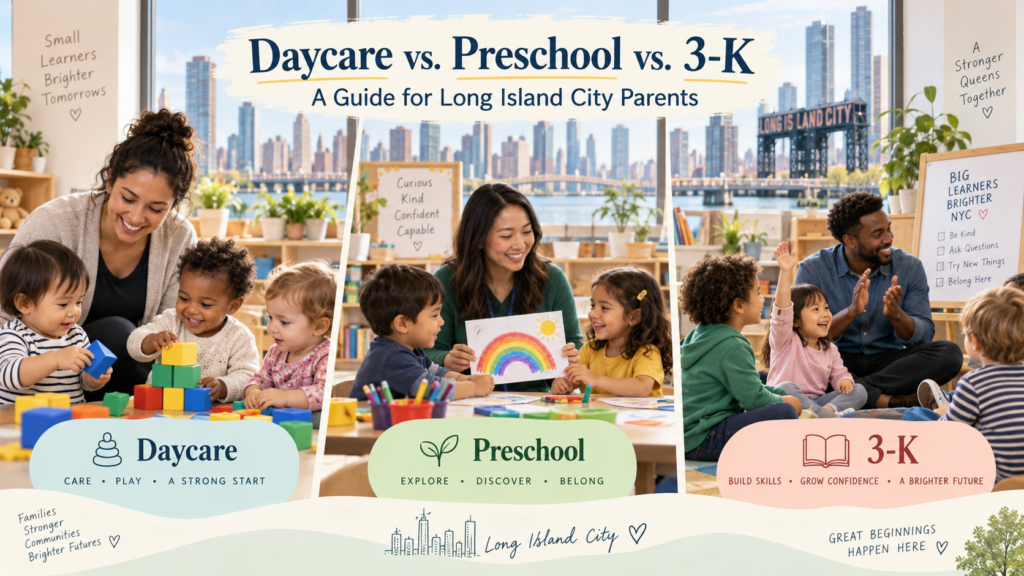


Below is a simple, parent-friendly guide to help you understand what to look for—and how to feel confident in your final choice.
Why the Right Daycare Matters
High-quality early childhood programs have been linked to stronger language, social, and cognitive outcomes. Studies from the National Institute of Child Health and Human Development (NICHD) and the Harvard Center on the Developing Child show that responsive relationships, consistent routines, and rich learning environments can significantly affect a child’s long-term development.
A great daycare doesn’t just watch children—it nurtures them.
Steps for Choosing the Right Daycare
- Identify Your Family’s Needs
Before touring programs, clarify what matters most for your family:
- Hours and schedule flexibility
- Location and commute
- Budget
- Desired teacher-to-child ratio
- Program philosophy (play-based? structured? Montessori-inspired?)
- Availability of extras like extracurriculars, meals, or enrichment
Knowing what you need makes it easier to narrow your options.
- Observe Classroom Interactions
Quality care is built on relationships. During your visit, look for:
- Warm, responsive teachers
- Calm, positive communication
- Gentle redirection instead of punishment
- Teachers who sit, play, and talk with the children at their level
Research consistently shows that secure attachments—even with non-parent caregivers—are tied to better emotional regulation and problem-solving skills.
- Ask About Learning Opportunities
A strong program offers more than supervision. Ask how children explore:
- Fine motor skills
- Gross motor skills
- Early language and literacy
- Social and play skills
- Cognitive problem-solving
If the daycare offers extracurricular activities (like art, music, second language exposure, sports, or creative play), this can boost confidence, motor skills, and early brain development.
- Review Safety and Cleanliness Standards
Safety should be non-negotiable. Look for:
- Secured entry and sign-in/out procedures
- Clean, organized spaces
- Age-appropriate toys and equipment
- Visible first-aid kits
- Safe sleep practices
- Staff trained in CPR and first aid
Trust your instincts—if the classroom feels chaotic or unsafe, it likely is.
Long Island City / NYC-Specific Daycare Considerations
Families in LIC navigate additional requirements because local programs follow NYC Department of Health and Mental Hygiene (DOHMH) regulations. This section helps you understand what to look for.
NYC Licensing and Inspection Requirements
- Ask to see the program’s NYC Group Child Care Center permit.
- Permits must be renewed every two years.
- Licensing is non-transferable and must match the physical location you are touring.
- Programs are inspected by Public Health Sanitarians and Early Childhood Consultants, and results should be available upon request.
These documents show whether the daycare meets NYC sanitation, safety, and operational standards.
NYC Staff-to-Child Ratios and Group Sizes
NYC has legally required minimum staffing levels. Below are some of the most common:
- Under 12 months: 1 adult for every 3–4 infants; group size up to 8
- 12–24 months: 1 adult for every 5 toddlers; group size up to 10
- 2–3 years: 1 adult for every 6 children; group size up to 12
- 3–4 years: 1 adult for every 10 children; group size up to 15
- 4–5 years: 1 adult for every 12 children; group size up to 20
Programs must maintain constant supervision, with staff always able to see and respond to children immediately.
NYC Safety Requirements
Ask how the center handles:
- Emergency planning and evacuation
- Outdoor play in an urban setting
- Building access and visitor management
- Supervision during transitions and walks
- Health screening and illness policies
Because LIC is densely populated, these procedures matter even more.
Parent Checklist for Choosing a Daycare
Use this to compare programs during tours.
Caregiver Interaction
- ☐ Teachers interact warmly with children.
- ☐ Staff guide behavior with patience and respect.
- ☐ Adults engage through conversation, reading, and play.
Environment & Daily Routine
- ☐ Classrooms are clean, bright, and child-centered.
- ☐ There are defined spaces for quiet play, art, building, and movement.
- ☐ Daily routine includes outdoor/gross-motor play.
- ☐ Learning experiences support language, problem-solving, and social growth.
Safety & Health
- ☐ Secure entry and clear check-in/out procedures.
- ☐ Emergency plans visibly posted and explained clearly.
- ☐ Age-appropriate toys and equipment.
- ☐ CPR- and first-aid-trained staff on site.
LIC / NYC Licensing & Compliance
- ☐ NYC Group Child Care permit is posted and current.
- ☐ Permit matches the program address.
- ☐ NYC staff-to-child ratios are met or exceeded.
- ☐ Inspection results or performance summaries are available.
- ☐ Supervision practices follow NYC rules (direct line of sight).
- ☐ Infant programs have an emergency staffing/safety plan.
- ☐ For home-based programs: license type is clearly explained and current.
Staff Qualifications & Professionalism
- ☐ Teachers have early childhood training or certifications.
- ☐ Staff turnover is low and educators appear happy in their roles.
- ☐ Background checks and ongoing training are completed regularly.
Communication with Parents
- ☐ Program provides daily or weekly updates.
- ☐ Staff are approachable and welcome questions.
- ☐ Transparent communication about policies, licensing, and incidents.
Overall Fit for Your Family
- ☐ Children look happy, comfortable, and engaged.
- ☐ Your child seems at ease during the visit.
- ☐ You feel confident, respected, and informed.
- ☐ The program aligns with your family’s needs and values.
Final Thoughts
Choosing a daycare in Long Island City involves balancing your heart—wanting your child to feel safe and loved—with your head—understanding NYC’s licensing, ratios, and health requirements. When you combine your intuition with a solid understanding of what quality care looks like, you’ll be able to find a nurturing, reliable environment where your child can grow and thrive.