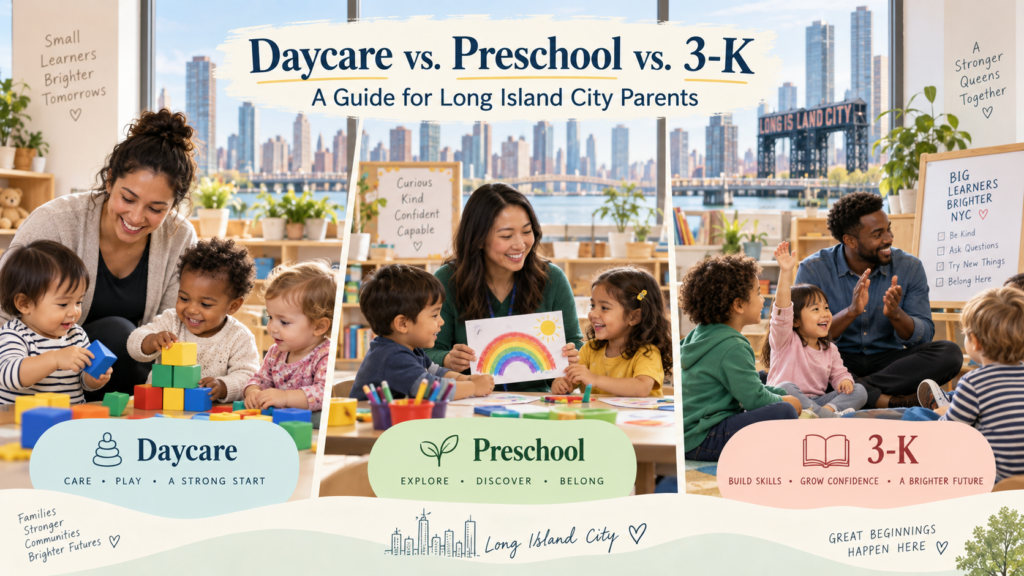

For families in Long Island City, finding affordable, high-quality child care is an important part of planning for a child’s early education. Fortunately, New York City offers several programs that can help reduce child care expenses, including income-based child care vouchers, free 3-K, and Universal Pre-K (UPK).
Understanding which programs your family qualifies for can make navigating child care options easier. This guide explains the available assistance, current income requirements, and how to find suitable daycare and preschool programs in Long Island City.
What Daycare Assistance Programs Are Available in Long Island City?
New York City families may have access to several types of child care assistance:
ACS Child Care Vouchers: Financial assistance for eligible families to help cover child care expenses at participating providers.
DOE 3-K: Free early childhood education for eligible three-year-olds through NYC Public Schools.
Universal Pre-K (UPK): Free educational programs for NYC children who turn four during the enrollment calendar year.
Extended Day and Year Programs: Longer daily schedules and year-round care for families meeting certain income and eligibility requirements.
Although these programs share the goal of making early childhood education more accessible, their eligibility requirements and enrollment processes differ.
ACS Child Care Vouchers: Who Qualifies?
The NYC Administration for Children’s Services (ACS) provides child care vouchers that help eligible families pay for care while parents work, attend school, or participate in other qualifying activities.
Eligibility generally depends on household income, family size, residency, the child’s eligibility, and an approved reason for needing care.
Qualifying circumstances may include:
Working at least 10 hours per week
Attending school or vocational training
Actively seeking employment
Living in temporary housing
Receiving certain domestic violence or substance use treatment services
Child care vouchers may cover some or all approved care expenses, although certain families are responsible for a portion of the cost.
For additional details, visit NYC’s official Child Care Voucher resource.
What Are the Income Limits for Child Care Assistance in NYC?
ACS generally uses an income threshold of 85% of New York State Median Income when determining financial eligibility.
The following table outlines annual household income limits from NYC’s 2026 ACS eligibility chart:
| Household Size | Annual Income Limit |
|---|---|
| 2 people | $79,214.90 |
| 3 people | $97,853.70 |
| 4 people | $116,492.50 |
| 5 people | $135,131.30 |
| 6 people | $153,770.10 |
Source: NYC ACS 2026 Income Eligibility Chart. These figures may change, and meeting an income threshold does not guarantee assistance.
Important: Due to funding limitations, NYC currently places many otherwise eligible new applicants who are not receiving cash assistance on a voucher waitlist. Families should consult ACS for current availability and priority rules.
How to Apply for an ACS Child Care Voucher
Families can begin by visiting MyCity NYC to review child care assistance options and eligibility.
The general process involves checking eligibility, submitting required household and income documentation, and following ACS instructions regarding applications or waitlists.
Once a voucher is approved, families can choose an eligible participating provider.
Building Brilliance Day Care LIC accepts ACS child care vouchers and welcomes families interested in using approved assistance for its child care programs, subject to enrollment availability.
What Is DOE 3-K in New York City?
NYC’s 3-K program provides free early childhood education to children who turn three during the calendar year they begin the program.
For example, children born in 2023 are eligible for the 2026–2027 school year.
School Day 3-K seats are available to NYC families regardless of household income, although placement depends on program availability. These programs generally operate for six hours and twenty minutes daily during the school year.
Some locations also offer Extended Day and Year seats, with additional eligibility requirements.
Families can review participating locations, admissions information, and current deadlines through the NYC Public Schools 3-K enrollment page.
Is DOE 3-K the Same as Private Daycare?
Not necessarily. Although both support early childhood learning, their schedules, enrollment processes, and funding arrangements may differ.
Families who need longer daily care or year-round coverage should compare DOE-funded options with private toddler daycare programs to determine which arrangement best supports their needs.
What Is Universal Pre-K (UPK)?
Universal Pre-K, commonly called UPK or Pre-K for All, provides free early childhood education to NYC children who turn four during the calendar year they enroll.
Unlike income-based child care vouchers, standard school-day Pre-K is not restricted to families below a specific income threshold.
Programs focus on developing foundational skills through age-appropriate activities, including language development, early literacy, mathematics, social interaction, and creative exploration.
Families can apply through NYC Public Schools and review available programs on the official Pre-K enrollment website.
Does UPK Cover Full-Day Child Care?
Standard Pre-K provides a school-day educational schedule, but that does not necessarily cover a parent’s entire workday.
Eligible families may have access to Extended Day and Year options, while others may need supplemental care.
Parents comparing early education choices can also explore the Building Brilliance preschool program for children ages three to five.
How Do You Choose the Right Child Care Program?
When comparing daycare assistance and preschool options in Long Island City, consider your child’s age, your family’s eligibility, and your scheduling needs.
A family with a two-year-old may find ACS voucher assistance especially relevant, while families with three- or four-year-olds should also investigate free DOE education programs.
Other important factors include program hours, location, educational approach, available spaces, and whether the provider accepts your approved assistance.
Remember that ACS vouchers, DOE 3-K, and UPK are separate enrollment and funding pathways. A daycare provider’s acceptance of ACS vouchers does not automatically mean it offers DOE-funded 3-K or UPK seats.
Frequently Asked Questions About Daycare Assistance in LIC
Can I qualify for child care assistance if both parents work?
Yes. Working families may qualify for ACS assistance if they meet the applicable income, activity, and other eligibility requirements. Funding availability also affects when assistance can begin.
Is 3-K free for all NYC families?
School-day 3-K is tuition-free and open to NYC children in the eligible age group, regardless of family income. Admission to a particular location depends on available seats.
Can I use an ACS voucher at a private daycare in Long Island City?
Yes, provided the daycare participates in the voucher program and the family’s voucher and enrollment arrangements are approved. Building Brilliance Day Care LIC accepts ACS vouchers.
Are 3-K and UPK the same program?
No. 3-K serves children turning three during the enrollment year, while UPK serves children turning four. Both offer free early childhood education through NYC Public Schools.
Explore Child Care Options at Building Brilliance Day Care LIC
Located at 1-14 56th Avenue in Long Island City, Building Brilliance provides licensed child care for children ages one to five, with programs emphasizing emotional, physical, and educational development.
Families exploring daycare assistance or considering private child care options are welcome to learn more about the center’s programs and ACS voucher participation.
Contact Building Brilliance Day Care LIC or call 718-750-1001 to ask about availability and schedule a tour.
Program eligibility, income limits, funding, and enrollment requirements are subject to change. Families should confirm current information directly with NYC ACS or NYC Public Schools.